
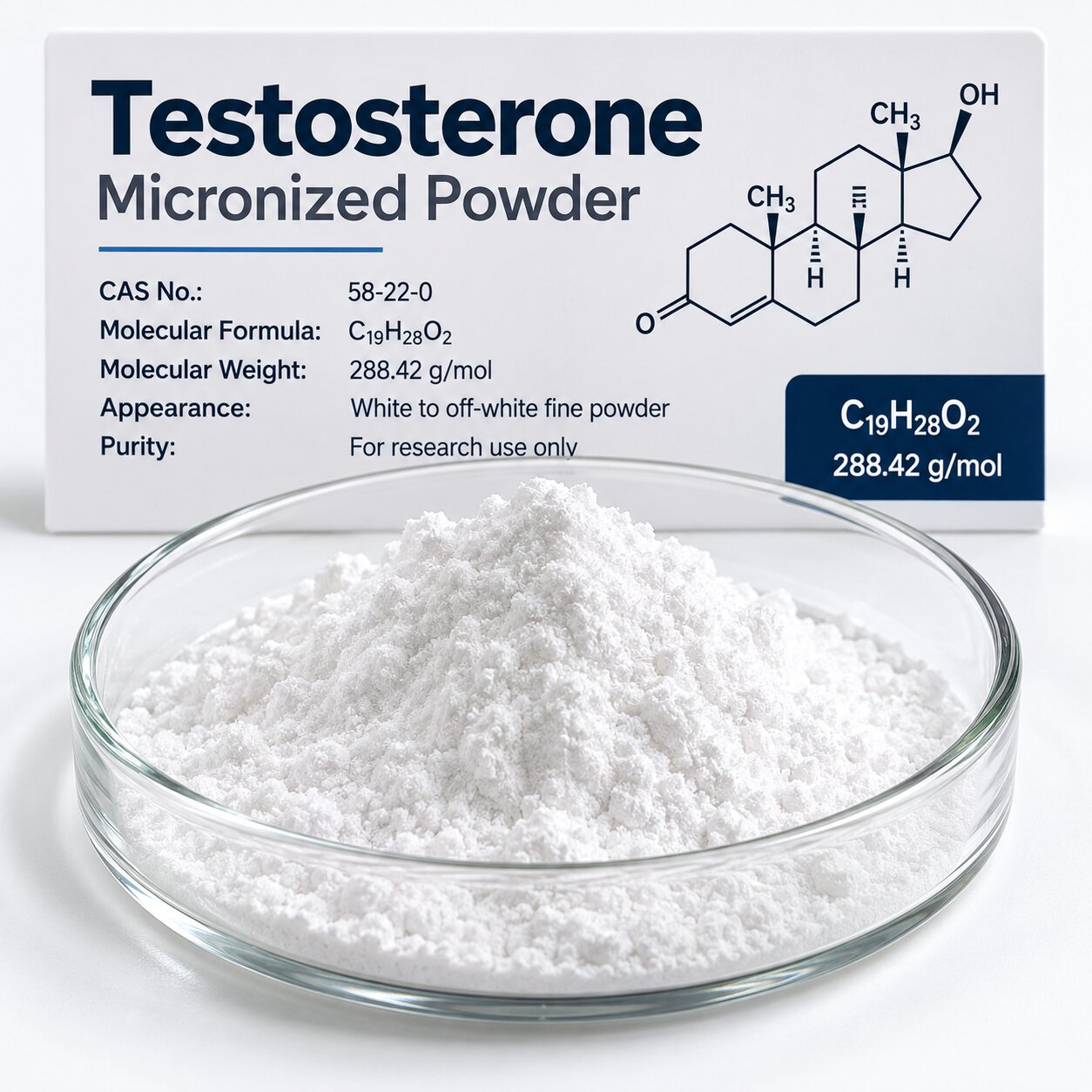
Testosterone Micronized Powder
Testosterone Micronized Powder is a finely processed testosterone research material identified by CAS No. 58-22-0, with the molecular formula C19H28O2 and molecular weight 288.42 g/mol. Testosterone is a naturally occurring steroid hormone present in both men and women and is studied in endocrine, analytical, pharmaceutical, and laboratory research.
Micronization refers to the physical processing of the material into a finer particle-size form. It does not change the underlying chemical identity of testosterone. Particle characteristics can be relevant to laboratory studies involving material characterization, analytical sample preparation, and powder behavior.
This product is presented for permitted laboratory, analytical, scientific, and research applications only.
Testosterone Micronized Powder Overview
Testosterone belongs to the steroid hormone and androgen class. In research settings, it can be studied through its chemical structure, molecular identity, analytical characteristics, metabolism, and relationship with other steroid compounds.
The micronized form provides a finely processed physical material for research where particle characteristics may be relevant.
Product Specifications
| Specification | Details |
|---|---|
| Product Name | Testosterone Micronized Powder |
| Chemical Name | Testosterone |
| CAS Number | 58-22-0 |
| Molecular Formula | C19H28O2 |
| Molecular Weight | 288.42 g/mol |
| Chemical Class | Steroid hormone / androgen |
| Physical Form | Fine powder |
| Processing | Micronized |
| Research Application | Laboratory and analytical research |
| Documentation | COA and applicable product documentation |
What Is Testosterone Micronized Powder?
Testosterone Micronized Powder is testosterone processed into a finer particle-size form.
The chemical identity remains testosterone. Micronization relates to the physical characteristics of the powder rather than creating a new testosterone compound.
Depending on the research objective, particle size may be evaluated in relation to powder morphology, surface-area characteristics, dispersion, handling properties, and analytical sample preparation.
The actual particle-size distribution should be determined through appropriate testing rather than assumed from the term “micronized.”
Chemical Identification and Properties
Accurate chemical identification is important when working with testosterone and structurally related steroid compounds.
Key Chemical Information
- CAS Number: 58-22-0
- Molecular Formula: C19H28O2
- Molecular Weight: 288.42 g/mol
- Chemical Name: Testosterone
- Chemical Class: Steroid hormone
- Compound Type: Androgen
These identifiers can be used for laboratory records, analytical documentation, material identification, and research workflows.
What Does Micronized Mean?
Micronization is a physical processing approach used to produce smaller particles.
For research purposes, the micronized form may be characterized by:
- Fine particle size
- Increased surface-area-to-volume ratio
- Powder-flow characteristics
- Dispersion behavior
- Physical consistency
- Particle-size-dependent analytical characteristics
Micronization should not be confused with chemical modification. A micronized testosterone material remains testosterone unless another chemical modification has been performed.
Testosterone Research in Men and Women
Testosterone occurs naturally in both male and female physiology, making it relevant to research involving both biological models.
The chemical identity remains the same, while the research question, biological model, and interpretation of results may differ.
Male Research Context
Male-focused research may examine testosterone in relation to:
- Androgen biology
- Endocrine physiology
- Testosterone concentration
- Steroid metabolism
- Hormone measurement
- Endocrine biomarkers
- Steroid analytical profiles
Female Research Context
Female-focused research may examine testosterone in relation to:
- Female endocrine physiology
- Steroid hormone interactions
- Testosterone concentration
- Hormone measurement
- Steroid metabolism
- Reproductive research
- Endocrine biomarkers
Male vs. Female Research
| Research Context | Male Research | Female Research |
|---|---|---|
| Biological context | Androgen and endocrine physiology | Female endocrine and steroid-hormone physiology |
| Research focus | Testosterone concentration, metabolism and androgen-related pathways | Testosterone concentration, metabolism and hormone interactions |
| Analytical research | May be evaluated alongside endocrine markers | May be evaluated alongside steroid and endocrine markers |
| Chemical identity | C19H28O2 / CAS 58-22-0 | C19H28O2 / CAS 58-22-0 |
| Interpretation | Based on the research model and objective | Based on the research model and objective |
Key point: Testosterone is the same chemical compound in both research contexts. The research model and scientific question determine how the resulting data are evaluated.
Research Applications
Testosterone Micronized Powder may be relevant to permitted laboratory research involving steroid chemistry and analytical science.
Chemical Characterization
Researchers may investigate the molecular identity and chemical characteristics of testosterone using appropriate analytical techniques.
Analytical Research
Testosterone can be studied in analytical procedures involving identification, characterization, quantification, and comparison of steroid compounds.
Steroid Chemistry Research
Testosterone can be examined alongside related steroid compounds to investigate molecular structure, chemical characteristics, and analytical behavior.
Particle Characterization
Because the material is micronized, researchers may investigate particle-size distribution, morphology, physical consistency, and related material properties.
Pharmaceutical and Formulation Research
Testosterone may also be examined in pharmaceutical-science research involving steroid compounds, subject to applicable laboratory, institutional, and regulatory requirements.
Testosterone Micronized Powder vs. Standard Testosterone Powder
Micronized and standard testosterone powders have the same underlying chemical identity when both materials are testosterone. The primary distinction is their physical particle characteristics.
| Characteristic | Micronized Testosterone | Standard Testosterone Powder |
|---|---|---|
| Chemical identity | Testosterone | Testosterone |
| CAS | 58-22-0 | 58-22-0 |
| Molecular formula | C19H28O2 | C19H28O2 |
| Molecular weight | 288.42 g/mol | 288.42 g/mol |
| Particle characteristics | Finer particle processing | Particle distribution depends on material |
| Chemical modification | Not implied by micronization | Not implied |
| Research consideration | Particle characteristics may be relevant | General powder characteristics may be evaluated |
Actual particle-size differences should be established through appropriate material-characterization testing.
Testosterone Micronized Powder vs. Testosterone Esters
Micronization and esterification describe two different concepts.
Micronization is a physical processing characteristic.
Esterification involves chemical modification of the testosterone molecule and results in a different compound.
Examples of related testosterone compounds include:
- Testosterone — CAS 58-22-0
- Testosterone Cypionate
- Testosterone Enanthate
- Testosterone Propionate
These compounds should be distinguished by their individual chemical identities rather than treated as interchangeable research materials.
Researchers can review related compounds in the Testosterone Steroid Powder category.
Analytical Testing
Analytical testing can help characterize research materials and confirm that documented specifications correspond to the material being evaluated.
Depending on the research objective, testing may examine:
- Chemical identity
- Assay or purity
- Related substances
- Physical appearance
- Particle-size distribution
- Material consistency
- Batch characteristics
- Stability-related properties
The appropriate analytical method depends on the research question, material specification, and laboratory procedures.
Certificate of Analysis (COA)
A Certificate of Analysis (COA) can provide batch-specific information about a research material.
Depending on the available documentation, a COA may include:
- Product name
- CAS number
- Batch or lot number
- Test date
- Appearance
- Identification result
- Assay or purity result
- Analytical method
- Specification
- Reported result
Researchers should ensure that documentation corresponds to the specific batch or lot being evaluated.
Research-Focused Benefits
The research value of Testosterone Micronized Powder is primarily associated with its defined chemical identity and physical characteristics.
- Defined chemical identity — CAS 58-22-0 and molecular formula C19H28O2.
- Micronized physical form — Provides a finer particle-size material for appropriate characterization studies.
- Male and female research relevance — Testosterone can be investigated in both male and female biological research models.
- Analytical research potential — Can be evaluated through appropriate identification, purity, and characterization methods.
- Steroid chemistry relevance — Can be studied alongside structurally related steroid compounds.
- Material characterization — Particle-size and physical properties can be investigated where relevant.
- Batch documentation — COA and related documentation can support laboratory records where available.
These are research and material-characterization considerations only and do not represent medical or therapeutic benefits.
Quality and Documentation
When evaluating a laboratory research material, researchers may consider both chemical specifications and supporting documentation.
Important documentation may include:
- Certificate of Analysis
- Safety Data Sheet
- Product specification
- Batch or lot identification
- Analytical information
- Storage information
- Handling information
Documentation should correspond to the actual material and applicable batch.
For related research materials, visit the Raw Steroid Powder category.
Storage and Laboratory Handling
Testosterone Micronized Powder should be handled according to the applicable product documentation, SDS, laboratory procedures, and regulatory requirements.
General laboratory considerations include:
- Keep the material in a properly sealed container.
- Protect it from unnecessary moisture exposure.
- Avoid unsuitable temperature conditions.
- Prevent contamination.
- Maintain clear product and batch labeling.
- Follow applicable SDS and laboratory handling requirements.
- Minimize unnecessary generation of airborne powder.
Specific storage requirements should be determined from the documentation supplied for the applicable material.
Frequently Asked Questions
What is Testosterone Micronized Powder?
Testosterone Micronized Powder is testosterone processed into a finer particle-size form. Its chemical identity remains testosterone, CAS No. 58-22-0.
What is the CAS number for Testosterone?
The CAS number for testosterone is 58-22-0.
What is the molecular formula of Testosterone?
The molecular formula is C19H28O2.
What is the molecular weight of Testosterone?
The molecular weight is 288.42 g/mol.
Is testosterone present in both men and women?
Yes. Testosterone occurs naturally in both males and females. Research involving the compound can use different biological models and research objectives.
What does micronized testosterone mean?
Micronized testosterone refers to testosterone processed into a finer particle-size form. Micronization concerns the physical characteristics of the material and does not by itself change the chemical identity.
Is micronized testosterone the same as testosterone cypionate?
No. Micronized testosterone refers to the physical form of testosterone, while testosterone cypionate is a chemically esterified testosterone compound with a different chemical identity.
Does micronization change the molecular formula?
No. Physical micronization does not inherently change the molecular formula of testosterone.
Can Testosterone Micronized Powder be studied in laboratory research?
It is presented for permitted laboratory, analytical, scientific, and research applications, subject to applicable laws, regulations, institutional requirements, and laboratory procedures.
Is a COA available?
Batch-specific documentation may be available depending on the material. Researchers should review the applicable COA and product documentation for the specific batch being evaluated.
Research and Compliance Disclaimer
Testosterone Micronized Powder is presented for permitted laboratory, analytical, scientific, and research applications only. The information on this page is provided for chemical and research reference purposes and does not constitute medical advice, treatment guidance, or instructions for human use. Researchers are responsible for complying with applicable laws, regulations, institutional policies, laboratory safety requirements, and chemical-handling procedures.


Reviews
There are no reviews yet.